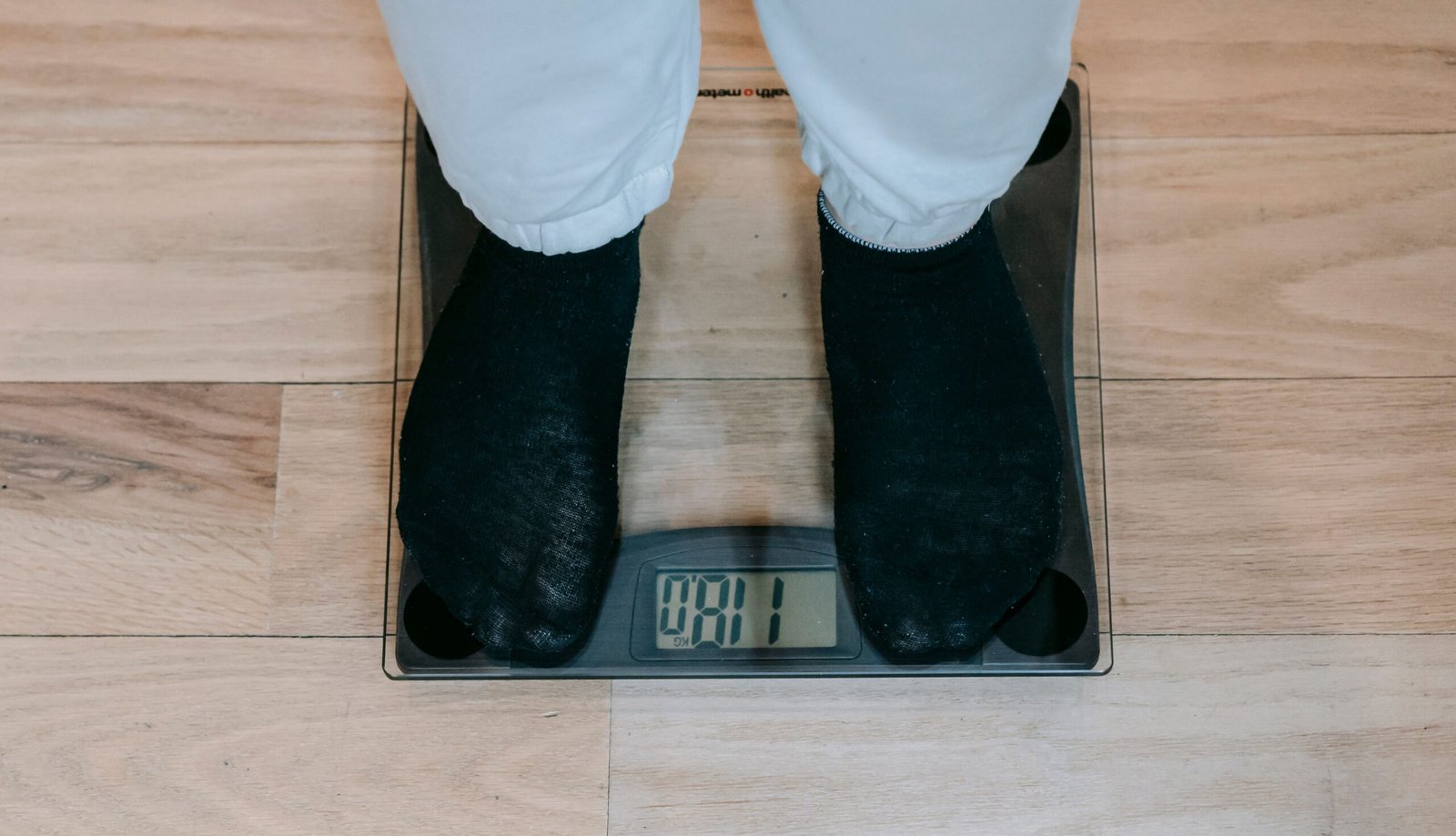

Weight loss stops after six months because your body has biologically adapted: your metabolism has slowed, your hunger hormones have shifted against you, and small habits have quietly loosened — all at the same time. The good news is that each of these has a specific, evidence-based fix, and you do not need to start over from scratch.
A 2024 Stanford University study found that weight loss almost always follows the same pattern: rapid progress in the early months, slowing between months three and six, and a full plateau by the six-month mark — regardless of which diet a person follows.1 Switching to a different diet at this point did not restart weight loss, suggesting the plateau is driven by biology, not by your food choices.
Introducing the Plateau Pyramid
To understand your plateau, it helps to think of it as a three-layer pyramid. Each layer represents a different reason why weight loss stalls — from deep physiological changes at the base, to hunger signals in the middle, to everyday habits at the top.
Most plateaus involve more than one layer. The key is to start at the base and work upward.
Layer 1 (The Foundation): Your Metabolism Has Slowed Down
What is happening?
When we look at a client’s calorie intake after a plateau, the first thing we check is whether their target has been recalculated for their new body weight — it almost never has. When you lose weight, your body needs fewer calories to function, simply because there is less of you to fuel. But it goes further than that. Your body also actively reduces how many calories it burns as a survival response. This is called metabolic adaptation.
Think of it like a car automatically shifting into fuel-saving mode on a long trip. Over time, the same amount of food that once created a calorie deficit now just keeps you at the same weight. The calorie equation that worked in month one no longer applies in month six.
Research shows that this metabolic slowdown can persist for over a year — even after active weight loss has stopped — meaning the effect is real and lasting, not just a short-term blip.2
Signs you are in this layer:
- You feel colder than usual, especially in your hands and feet
- Your energy is lower and you feel generally sluggish
- Your weight has stalled even though your tracking has been accurate
What to do:
- Recalculate your calorie needs. The number of calories your body needs has dropped alongside your weight. Use your current weight to recalculate your daily target — not the weight you started at.
- Try a planned diet break. A clinical trial known as the BREAK Study is testing a 2:1 approach: 14 days of reduced calories, followed by 7 days of eating at maintenance (not gaining, just not restricting).3 These short “maintenance phases” allow your metabolism to partially recover, making the next phase of restriction more effective.
Layer 2 (The Middle): Your Hunger Hormones Are Working Against You
What is happening?
In nutritional management, we treat hunger that persists despite an adequate calorie intake as a hormonal signal — not a willpower problem. As you diet, your body makes hormonal changes that are specifically designed to make you eat more. This is not a lack of willpower — it is a biological survival response that has been hardwired into humans for thousands of years.
A landmark study published in the New England Journal of Medicine found that these hormonal changes — including a rise in the hunger hormone ghrelin and a drop in the fullness hormone leptin — persisted for a full year after weight loss.4 Your brain is genuinely being told to find food, even when you know intellectually that you do not need more.
What changes in your hormones during dieting:
| Hormone | What it normally does | What happens when you diet |
| Leptin | Tells your brain you are full and satisfied | Drops — you stop feeling full after meals |
| Ghrelin | Signals hunger and drives appetite | Rises — your brain keeps sending hunger signals |
| Thyroid (T3) | Controls how fast your metabolism runs | Falls — your overall calorie burn slows further |
| Insulin | Signals that your body has plenty of energy | Falls — your body senses it is running low on fuel |
What to do:
- Eat more protein. Sports nutrition research recommends aiming for protein to make up more than 25% of your total calories. Protein is the most filling macronutrient and helps your body hold onto muscle while losing fat.
- Use planned “refeed” days. Temporarily eating at your maintenance level — not overeating, just not restricting — can send a signal to your brain that food is available, briefly raising leptin and easing hunger. This is different from a cheat meal; it is a planned, structured pause.
- Prioritize sleep. Poor sleep raises ghrelin and makes hunger almost impossible to manage. Aiming for 7–9 hours is one of the most underrated tools for weight management.
Layer 3 (The Top): Small Habits Have Quietly Shifted
What is happening?
This layer is often triggered by the two below it. When your metabolism slows and hunger increases, something called “diet fatigue” sets in. The effort feels bigger, the results feel smaller, and without realizing it, small habits start to loosen.
This might show up as portions gradually getting larger (“portion creep”), a few extra bites here and there, or less spontaneous movement throughout the day. Research shows that people on long-term calorie restriction subconsciously move less — taking the elevator instead of the stairs, sitting more, fidgeting less. This is your body quietly trying to conserve energy.6
Signs you are in this layer:
- You have stopped measuring portions and are estimating by eye
- You notice you are less active in general, not just in your runs
- Eating feels more emotionally charged or reward-driven than it used to
What to do:
- Re-weigh your portions: Using a food scale can reveal where you have stopped being precise and where extra calories have “crept” back into your meals.7
- Use a food diary: Keeping a meticulous log for one week helps identify “reward eating” or intermittent slips in adherence that you may have overlooked.7
- Track your steps, not just your runs: Using a pedometer or smartwatch allows you to monitor your total daily movement, ensuring your NEAT levels haven’t dropped below your target (such as 10,000 steps per day)
Which Layer Is Driving Your Plateau?
Ask yourself these three questions to identify where to focus first:
- Am I estimating portions or moving less than I did in month one? → Start with Layer 3 (Habits)
- Am I constantly thinking about food and never feeling full? → Focus on Layer 2 (Hormones)
- Do I feel cold and tired even though my tracking is accurate? → You are facing Layer 1 (Metabolism)
Most plateaus involve all three layers to some degree. Always address the foundation — recalculate your calorie needs and consider a planned diet break — before moving up the pyramid.
The Bottom Line
A six-month plateau is not a sign that your body is broken or that you have failed. It is a sign that your body has adapted — and that your strategy needs to adapt too.
The three moves that the science points to most clearly are: recalculate your calorie target for your new body weight, increase your protein intake to protect muscle and manage hunger, and add short planned breaks from restriction to give your metabolism room to recover.
A plateau is not a stop sign. It is a checkpoint — and now you have the map to get through it.
Key References
References
- Landry MJ, Ward CP, Cunanan KM, Fielding-Singh P, Crimarco A, Gardner CD. Switching diets after 6-months does not result in renewed weight loss: a secondary analysis of a 12-month crossover randomized trial. Sci Rep. 2024 Apr 29;14(1):9865. doi: 10.1038/s41598-024-60547-z. PMID: 38684815; PMCID: PMC11058757.
- Trexler, E. T., Smith-Ryan, A. E., & Norton, L. E. (2014). Metabolic adaptation to weight loss: implications for the athlete. Journal of the International Society of Sports Nutrition, 11(1). https://doi.org/10.1186/1550-2783-11-7
- The BREAK study protocol: Effects of intermittent energy restriction on adaptive thermogenesis during weight loss and its maintenance
Cortez FM, Nunes CL, Sardinha LB, Silva AM, Teixeira VH (2023) The BREAK study protocol: Effects of intermittent energy restriction on adaptive thermogenesis during weight loss and its maintenance. PLOS ONE 18(11): e0294131. https://doi.org/10.1371/journal.pone.0294131 - P. Sumithran, L.A. Prendergast, E. Delbridge, K. Purcell, A. Shulkes, A. Kriketos, et al. Long-term persistence of hormonal adaptations to weight loss N Engl J Med, 365 (2011), pp. 1597-1604
- Jäger R, Kerksick CM, Campbell BI, Cribb PJ, Wells SD, Skwiat TM, Purpura M, Ziegenfuss TN, Ferrando AA, Arent SM, Smith-Ryan AE, Stout JR, Arciero PJ, Ormsbee MJ, Taylor LW, Wilborn CD, Kalman DS, Kreider RB, Willoughby DS, Hoffman JR, Krzykowski JL, Antonio J. International Society of Sports Nutrition Position Stand: protein and exercise. J Int Soc Sports Nutr. 2017 Jun 20;14:20. doi: 10.1186/s12970-017-0177-8. PMID: 28642676; PMCID: PMC5477153.
- Trexler ET, Smith-Ryan AE, Norton LE. Metabolic adaptation to weight loss: implications for the athlete. J Int Soc Sports Nutr. 2014 Feb 27;11(1):7. doi: 10.1186/1550-2783-11-7. PMID: 24571926; PMCID: PMC3943438.
- Sarwan G, Daley SF, Rehman A. Management of Weight Loss Plateau. 2024 Dec 11. In: StatPearls [Internet]. Treasure Island (FL): StatPearls Publishing; 2026 Jan–. PMID: 35015425.