

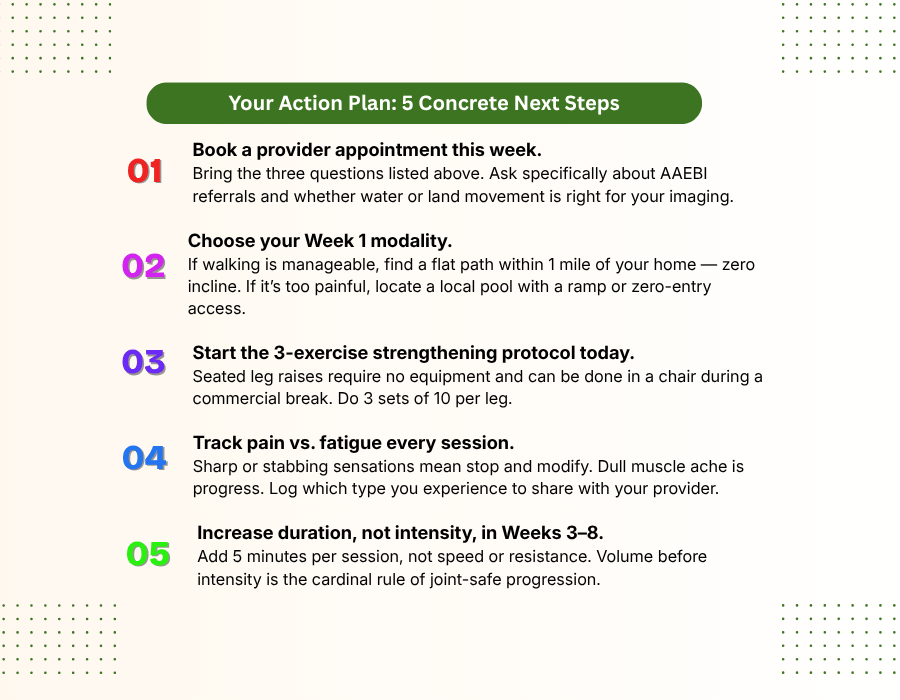
The safest way to start cardio with chronic joint pain is flat-surface walking for 10–15 minutes, 3x per week — zero pain, zero impact, and backed by more clinical research than any other intervention for osteoarthritis.
If you live with chronic joint pain, the suggestion to “just get some exercise” can feel like a cruel contradiction. Globally, more than 302 million people navigate osteoarthritis (OA).1 Many are caught in what we call the Vicious Cycle: joint pain leads to reduced activity, which triggers weight gain. That extra weight increases mechanical load on the joints, causing more pain and further inactivity.
This cycle is particularly dangerous because OA rarely travels alone — one-third of adults with OA live with five or more chronic conditions, including cardiovascular disease and diabetes.1
The Science of Why It Hurts: Load and Inflammation
To move smarter, we need to understand the two-front war being waged on your joints:
- Mechanical load: The literal physical weight pressing down on cartilage with every step.
- Systemic inflammation: Excess adipose tissue isn’t just stored energy — it’s chemically active, releasing inflammatory markers that accelerate joint tissue degradation.
When analyzing a patient’s movement profile, the single most powerful ratio I work with is the 1:4 Rule: every 1 pound of body weight lost results in a 4-pound reduction in load on the knee joints.1 This is why even modest, consistent movement creates outsized results.
As you begin moving, learn to distinguish between two types of physical feedback:
- Joint Pain: A sharp, stabbing, or “catching” sensation. Stop, rest, and modify.
- Muscle Fatigue: A dull, heavy ache in the muscles surrounding the joint. This is a normal adaptation — your “shock absorbers” getting stronger.
Your Medical Launchpad: 3 Questions to Ask Your Provider
Before starting, consult a healthcare provider — not just for safety clearance, but because data shows adults who receive specific counseling from their providers are four times more likely to successfully make lasting activity changes.1 Think of your doctor as a launch consultant, not a gatekeeper.
In nutritional management and movement rehabilitation, we look at both the physical and psychological readiness of a patient. These three questions will get you the most useful information from a single appointment:
- “Are there specific ‘red flag’ symptoms — beyond standard aching — that should tell me to stop immediately?”
- “Can you refer me to an AAEBI (Arthritis-Appropriate, Evidence-Based Intervention)? Programs like ‘Walk With Ease’ are specifically reviewed for safety and efficacy in joint conditions.”
- “Based on my imaging and symptoms, should I prioritize water-based or land-based movement first?”
The Best Cardio Options for Joint Pain (Ranked by Evidence)
The “best” activity depends on where you hurt. Based on recent meta-analyses, here is the evidence-backed hierarchy:
- Flat-Surface Walking (Gold Standard for Knee/Hip OA): Walking is the most researched exercise intervention for osteoarthritis.1 It delivers the necessary mechanical stress to maintain cartilage integrity without excessive impact. Walking up to 10,000 steps per day has been confirmed safe and does not worsen joint health.
- Water Exercise & Swimming (Gold Standard for Chronic Back Pain): If your primary struggle is low back pain, aquatic exercise ranks #1 for functional recovery.2 Buoyancy reduces spinal load; hydrostatic pressure manages swelling.3 Studies show that water-based exercises significantly improve pain, balance, and quality of life.4 It’s also the ideal entry point for those who find land-based walking too painful to start.
- Stationary or Recumbent Cycling: A low-impact option that builds quadriceps strength while offloading the spine (recumbent models).1 Excellent for those with both knee and back involvement.
What to delay: High-impact activities like running and jumping should wait until your pain is managed and your supporting musculature is significantly stronger.
Your 8-Week “Start Where You Are” Plan
Public health guidelines target 150 minutes of moderate activity per week. We build toward that — but we begin where you actually are. Even 45 minutes per week has been shown to meaningfully improve joint function.1
| Phase (Weeks) | Duration / Frequency | The “Golden Rule” Goal |
| Weeks 1–2 | 10–15 min sessions, 3x/week | Zero Pain: Recalibrate the nervous system’s alarm response. |
| Weeks 3–4 | 20 min sessions, 3–4x/week | Consistency: Improve sleep quality and reduce sedentary time. |
| Weeks 5–8 | Build toward 30 min, 4–5x/week | Capacity: Gradually reach the 150-minute weekly guideline. |
The “Shock Absorber” Protocol: Strengthening Your Support
To protect your joints during cardio, you must strengthen the muscles around them. When analyzing a patient’s knee mechanics, the quadriceps are always the first target — they are the primary shock absorbers of the knee joint. Three exercises to begin immediately:
- Seated Leg Raises: Sit in a sturdy chair, straighten one leg, hold for 3 seconds, and lower slowly. Directly targets the quads to improve knee stability with zero joint load.
- Partial Wall Sits: Back against a wall, slide down to no more than a 45-degree angle. Builds muscular shock absorption so your muscles take the impact, not your cartilage.
- Gentle Core Engagement: While seated or standing, gently draw your belly button toward your spine. A stable core reduces load on the hips and lower back during all cardio activities.
Addressing Kinesiophobia: The Fear That Holds People Back
Many patients suffer from kinesiophobia — the clinical term for fear of movement, rooted in the belief that exercise causes “wear and tear.” Medical evidence directly contradicts this.5 Recreational walking does not cause OA progression. Focus on micro-wins: a pain-free 10-minute walk is a genuine clinical victory for both your cardiovascular system and your cartilage.
References
- Huffman KF, Ambrose KR, Nelson AE, Allen KD, Golightly YM, Callahan LF. The Critical Role of Physical Activity and Weight Management in Knee and Hip Osteoarthritis: A Narrative Review. J Rheumatol. 2024 Mar 1;51(3):224-233. doi: 10.3899/jrheum.2023-0819. PMID: 38101914; PMCID: PMC10922233.
- Jurado-Castro JM, Muñoz-López M, Ledesma AS, Ranchal-Sanchez A. Effectiveness of Exercise in Patients with Overweight or Obesity Suffering from Knee Osteoarthritis: A Systematic Review and Meta-Analysis. Int J Environ Res Public Health. 2022 Aug 24;19(17):10510. doi: 10.3390/ijerph191710510. PMID: 36078226; PMCID: PMC9518463.
- Caiado VS, Santos ACG, Moreira-Marconi E, Moura-Fernandes MC, Seixas A, Taiar R, Lacerda ACR, Sonza A, Mendonça VA, Sá-Caputo DC, Bernardo-Filho M. Effects of Physical Exercises Alone on the Functional Capacity of Individuals with Obesity and Knee Osteoarthritis: A Systematic Review. Biology (Basel). 2022 Sep 23;11(10):1391. doi: 10.3390/biology11101391. PMID: 36290296; PMCID: PMC9598071.
- Aali S, Rezazadeh F, Imani F, Sefidekhan MN, Badicu G, Poli L, Fischetti F, Cataldi S, Greco G. Effects of Exercise-Based Rehabilitation on Lumbar Degenerative Disc Disease: A Systematic Review. Healthcare (Basel). 2025 Aug 7;13(15):1938. doi: 10.3390/healthcare13151938. PMID: 40805971; PMCID: PMC12346320.
- Peng MS, Wang R, Wang YZ, Chen CC, Wang J, Liu XC, Song G, Guo JB, Chen PJ, Wang XQ. Efficacy of Therapeutic Aquatic Exercise vs Physical Therapy Modalities for Patients With Chronic Low Back Pain: A Randomized Clinical Trial. JAMA Netw Open. 2022 Jan 4;5(1):e2142069. doi: 10.1001/jamanetworkopen.2021.42069. Erratum in: JAMA Netw Open. 2024 Mar 4;7(3):e249399. doi: 10.1001/jamanetworkopen.2024.9399. PMID: 34994794; PMCID: PMC8742191.
You own the how
Turn this into meals: the NourishFix planner builds a week of balanced, filling meals and a shopping list.
Read next
 What is the best night meal for weight loss?By Shiundu Valerie, RDNDiscover the best night meal for weight loss. Learn how the "Protein-Fiber Sandwich" and meal timing optimize your metabolism while you sleep.
 How to lose belly fat with a high protein dietCan a high protein diet reduce belly fat? Discover how, optimal protein targets, and clinical evidence for targeting visceral
 How to deal with extreme hunger when starting a weight loss planStruggling with extreme hunger while dieting? Discover the why behind weight loss plateaus, how to manage cravings, and satiety strategies.
 How to eat enough protein with Ozempic food aversionStruggling to eat on Ozempic? Discover how To Eat Enough Protein with Ozempic Food Aversion and strategies to protect your muscle mass.
 Why am I gaining weight on Wegovy?Tracking macros but still gaining weight on Wegovy? Discover the reason behind weight loss plateaus and how to fix a stalled metabolism.
Sources
5 studies and guidelines behind this guide
Every NourishFix guide is written by a registered dietitian and draws on peer-reviewed research and clinical guidelines. How we choose and check sources